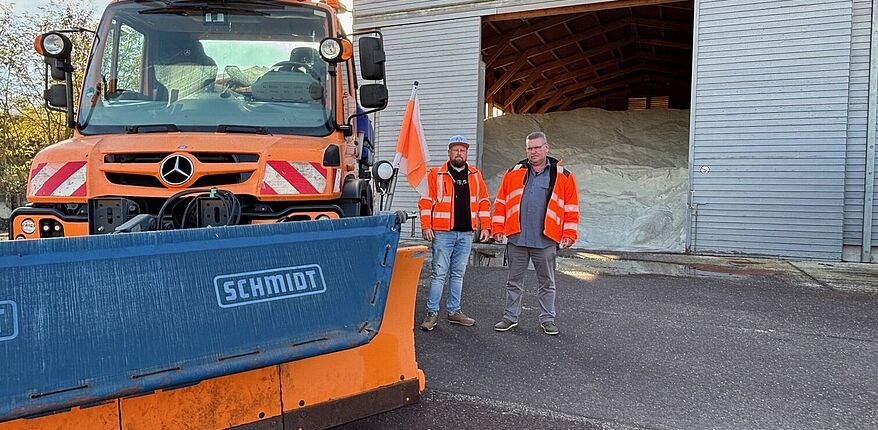
1,700 tonnes of salt and almost 60 tonnes of brine are currently available for clearing and gritting duties on the roads in the Börde district. If necessary, a further contingent of salt and brine is available. A tour covers an average of 50 kilometres (shortest tour: 45 kilometres, longest tour: 55 kilometres). There are also 2 small equipment carriers for clearing junctions or cycle paths. The control service is responsible for observing the weather and managing operations in order to ensure that the clearing work starts on time. They check the weather forecast for the following night/day in the morning and afternoon and decide where to carry out the winter service. The advantage of this is that several weather forecast sources can be used and information is therefore constantly updated.
Winter road maintenance is carried out in accordance with the provisions of the Federal Trunk Roads Act and the Road Act of the state of Saxony-Anhalt. The winter service is organised in such a way as to ensure that the roads are passable to the best of our ability from Monday to Friday from 07:00 to 22:00. For the crews of the winter service vehicles, this means working on the winter service vehicle on weekdays from 03:00 to 22:00 in two shifts. On Saturdays, if necessary, work is carried out from 04:00 to 20:00 and on Sundays from 05:00 to 22:00, also in early and late shifts. In icy conditions, four hours of work can be expected; if there is also snow, around six hours are scheduled for clearing and gritting work. In an average winter, the road maintenance team covers around 40,000 kilometres of gritting.
"The system is very flexible and the team is well-rehearsed. It is important to adapt and react to the weather conditions," emphasises Frank Holzheuer, Head of Road Maintenance in the Börde district. "During heavy snowfall, the district roads are also worked on in two shifts, but generally always in the early hours of the morning.
On average, the Börde district incurs costs of around 400,000 euros per year for winter road maintenance. These costs can increase significantly during prolonged winter weather. In the winter of 2024/2025, the costs were slightly lower than in the previous winter of 2023/2024. 107,000 euros was spent on services, 128,000 euros on materials and 70,000 euros on storage and maintenance costs. A total of 1,030 tonnes of salt and 278 tonnes of brine were used last winter.
The gritting itself is carried out using the so-called pre-wetted salt technique, which was specially developed for preventative gritting. In this case, the rock salt is first moistened with brine and only then spread on the carriageway. As a result, the salt adheres to the road for longer and is not blown away directly, as is the case with pure dry salt. "The moistened salt also reacts more quickly with frost, ice and snow. This is very effective for us," explains Holzheuer.
The district road maintenance depot mainly uses the FS 30 pre-wetted salt technology: Immediately before spreading, the solid road salt is mixed with a salt solution (brine) on the spreading disc. The mixing ratio is 70 per cent dry salt and 30 per cent brine. Sodium chloride, i.e. normal table salt, is used for the brine.
When deployed, the entire district road network is always gritted. The aim is to complete the clearing and gritting operations on the district's roads by 7 a.m. - in time for the start of rush hour traffic. "Our winter road clearance team is doing its utmost to clear the roads of ice and snow and ensure safety. However, we cannot guarantee that roads and paths will be completely free of ice and we cannot be everywhere at the same time," emphasises Frank Holzheuer. But even the best preparation on the part of the district road maintenance centres has its limits. Especially in heavy and prolonged winter weather, it is not possible to clear and grit everywhere at the same time. "Then our employees are working hard under the most difficult conditions," emphasises Head of Department Holzheuer.
"The experience and skills of the personnel deployed are always indispensable, without which even the best technology cannot be used effectively," emphasises department head Dr Denis Gruber. Even with the best preparation and an early start to the operation, it cannot be ruled out that a closed snow cover can be expected during prolonged snowfall. There is also always the possibility of icy and slippery conditions in places. If the snowfall only starts during rush hour, it is a particular challenge to clear the carriageways for moving traffic. This is because the moving traffic drives the snow onto the carriageway. It is also difficult for the snow clearing vehicles to get through. There is therefore no guarantee that drivers will be able to drive freely, explains department head Gruber. "All road users should exercise caution in snow and ice. Driving at a speed appropriate to the road conditions reduces the risk of accidents. Vehicles that are not adequately equipped for winter also repeatedly cause obstructions."