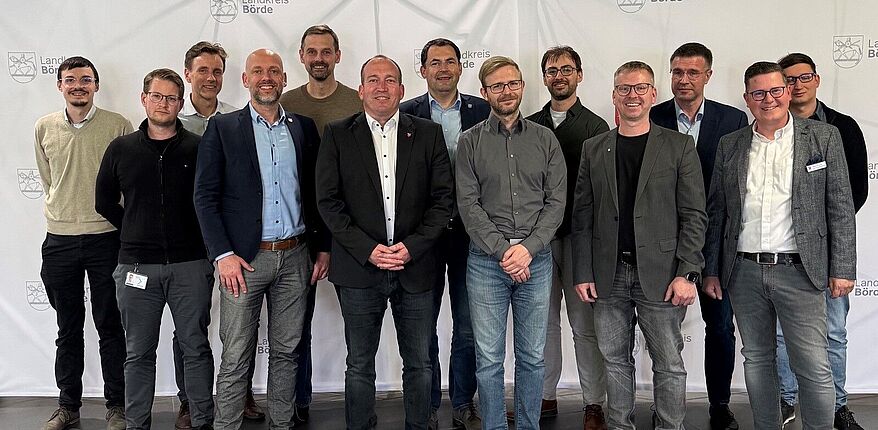
Funding totalling 450,000 euros is available to the Börde district for the period from March 2026 to October 2028. These federal funds are earmarked for the development of the Strategic Regional Development Concept (SREK). The SREK is not a rigid document, but a living roadmap that defines the guidelines for the next two decades. The funding is primarily used to adequately finance staff positions. The REGIOSTRAT project is intended to lay the foundations for proactive development.
The federal funding makes it possible to develop in-depth analyses and far-reaching networks that will last well beyond 2028. The end result will be a document politically legitimised by the district council, which will serve as a "door opener" for all future funding applications. The final aim is to identify measures that can be implemented over a timeframe up to 2040-2045.
The vision of the model region
Modern regional development faces challenges that, in their interconnectedness, far exceed the capacities of individual municipalities. The success of the SREK 2040 is inextricably linked to overcoming "parochial thinking". Strategic future planning today means not only invoking inter-municipal synergies, but also institutionalising them. The 13 municipalities belonging to the district form the backbone of the process.
Each municipality was analysed individually in order to precisely integrate local strengths - from the industrial core to the tourism niche - into the overall strategy. Only if the local identity is reflected in the SREK can the necessary political acceptance for large-scale decisions be achieved. The integration of HTP GmbH (High-Tech Park), the Helmstedt economic region and the Mittelland Canal economic region is of existential importance.
These partners are transforming the district from a passive location for logistics to an active player in the semiconductor ecosystem. This is not just about providing space, but also about integrating research, development and highly specialised skilled workers. The complexity of modern regional development cannot be tackled alone. The project is therefore based on close co-operation between politics, administration and business, and the Börde district has now also succeeded in establishing a network of administration, research and higher education institutions.
Its members are Thorsis Technologies GmbH (communication technology, traffic telematics), Ambulanz Mobile GmbH Schönebeck (vehicle construction, rescue vehicles, ambulances), VAVIA GmbH (driver assistance systems with a focus on safety), ifak e.v. (research institute with a focus on transport technologies), Galileo Test Field (transport technologies, drone technology), Anhalt-Köthen University of Applied Sciences (mobility, logistics).
The Strategic Regional Development Concept (SREK) to be drawn up is to be organised along three strategic fields of action that form the core of the region's future viability:
A. Services of general interest (quality of life in rural areas)
The aim is to secure basic services even in peripheral locations. This includes
Health: Establishing the "Health Network District of Börde" and trialling mobile medical services, including through the use of drone technology
Education: Networking schools and local businesses to secure skilled labour.
Local supply: Maintaining food markets and social meeting places in small communities.
B. Infrastructure (networking and digital transformation)
Modern infrastructure is the basis for growth. The SREK focusses on:
Mobility: A regional mobility concept that integrates on-demand transport and cycle paths (hiking and riding trails) and opens up opportunities for autonomous driving
Digitalisation: Broadband strategy and expansion of the charging infrastructure for electromobility
Energy: Regional energy cooperation to utilise renewable resources locally
C. Settlement area (sustainable design)
In view of the settlement pressure in the Magdeburg suburbs and the challenges in rural areas, the focus is on
Inner development: Revitalisation of town centres and vacancy management to reduce land consumption.
Commerce: An inter-municipal commercial space strategy to offer investors attractive locations without parochial thinking.
The SREK results in a concrete catalogue of measures. From a broad pool of around 30 potential projects, a prioritisation matrix is used to select 15 measures that promise a particularly high leverage effect for the region. These 15 priority measures are to be substantiated in detail with cost frameworks, timetables and potential funding programmes. The selection is to be made using a matrix that evaluates the impact (degree of effectiveness), feasibility (cost/time) and the degree of regional cooperation.
A central strategic focus is on the "demographic gap" in the context of the peripheral divide. While the bacon belt around Magdeburg is experiencing a renaissance due to the influx of skilled workers for the High-Tech Park (HTP), the peripheral areas are at risk of falling into a downward spiral of ageing and vacancy. This is not just a social problem, but also a fiscal one. Falling user numbers with fixed costs for supply networks and social facilities remaining the same lead to a high burden on municipal budgets.
Securing services of general interest in the area is the basic prerequisite for social stability and the retention of skilled labour. In a region that is transforming into a high-tech location, basic services must operate at the same technological level as industry. The goal is a "quality of life independent of location". The district must succeed in responding to the shortage of doctors, for example by creating mobile surgeries and establishing telemedicine services. Telemedicine services should therefore become standard in order to cover the first level of diagnosis comprehensively and promptly.
Where physical presence is essential, mobile medical care units will come onto the scene. The use of aerial robotics (drone technology) is a visionary milestone. By 2040, this could become a daily routine for the delivery of emergency medication and the transport of laboratory samples between rural outposts and centralised clinics. This decouples emergency medical care from the quality of the road network and saves vital minutes in the periphery. Physical "health hubs" in the basic centres not only provide treatment, but also serve as social anchor points against the isolation of an ageing population.
In order to stop the "brain drain", we are establishing a strategic alliance between educational institutions and industry. Through technology sponsorships, careers guidance no longer takes place in careers advice centres, but directly in the laboratories of semiconductor suppliers. This creates a psychological and professional bond between young people and the region at an early stage and ensures that companies have access to a locally rooted pool of skilled labour.
What will life in the countryside look like in the future? It can be assumed that the traditional village shop will be replaced by "digital village shops" that function as hybrid locations: Local supply, co-working space and social meeting place under one roof. This is complemented by mobile administrative services. The citizen no longer comes to the office; the office comes to the citizen in the form of fully equipped service vehicles or via digital interfaces. This reduces the need for long journeys and conserves administrative resources.
Another important question is how public transport in the Börde district will be organised in the 2040s. We can expect to see the implementation of autonomous shuttle buses that serve on-demand requests and close the "last mile" between railway stations and residential areas. Intelligent transport systems will also have a decisive influence. Thanks to their V2X technologies (vehicle-to-everything) and autonomous flight systems (drones), these will bring about a fundamental structural change in mobility and services of general interest in the Börde district. As the second-largest district in Saxony-Anhalt, the region can particularly benefit from bridging long distances digitally. To this end, the Börde district intends to mobilise the necessary funding.
Dr Denis Gruber, Head of Infrastructure and Environment in the Börde district, emphasises: "V2X technology enables seamless communication between vehicles, infrastructure and road users.Research is already underway intopreventative traffic control. In the 2040s, vehicles in the district will communicate with traffic lights and sensors in real time, which will minimise traffic jams and increase road safety. Local public transport will also be organised in line with demand. In remote communities, buses or autonomous shuttles could be controlled with pinpoint accuracy using V2X feedback (e.g. digital on-demand stops). Infrastructure monitoring will also be improved, as networked vehicles will automatically report road damage or icy conditions in winter to the road maintenance authorities."
Drones will close supply gaps in sparsely populated areas of the district.Medical care in particular is a key area of activity, with time-critical products such as medication, blood reserves or defibrillators being flown directly to patients or care homes within minutes. Projects such as the PalliDrohne in Saxony-Anhalt are already demonstrating the feasibility of these "flying pharmacies". Inthe future, everyday goods will alsoincreasingly be transported by drones . Local supply concepts enable the delivery of groceries from regional centres to remote districts, which reduces dependence on private cars, especially as the population living here is getting older and mobility is becoming more limited as people get older.
Head of department Gruber adds: "These technologies are a key future factor in ensuring the quality of life in rural areas by neutralising physical distance through digital and automated logistics and guaranteeing the quality of supply regardless of location ."
The strategic regional development concept (SREK) to be drawn up for the Börde district will focus on the following fields of action:
Possible examples of measures:
Field of action: Services of general interest
Mobile medical care in rural areas
Regional educational cooperation between schools and business
Digital health services
Regional childcare strategy
mobile administrative services
Infrastructure field of action
Regional mobility concept
Innovative public transport models (on-demand transport)
Electromobility charging infrastructure
Regional energy co-operation
Intelligent transport systems
Expansion of sustainable logistics
Settlement area field of action
Inner development programme for town centres
Vacancy management
Sustainable housing development
Revitalisation of derelict areas
Smart Village" model projects