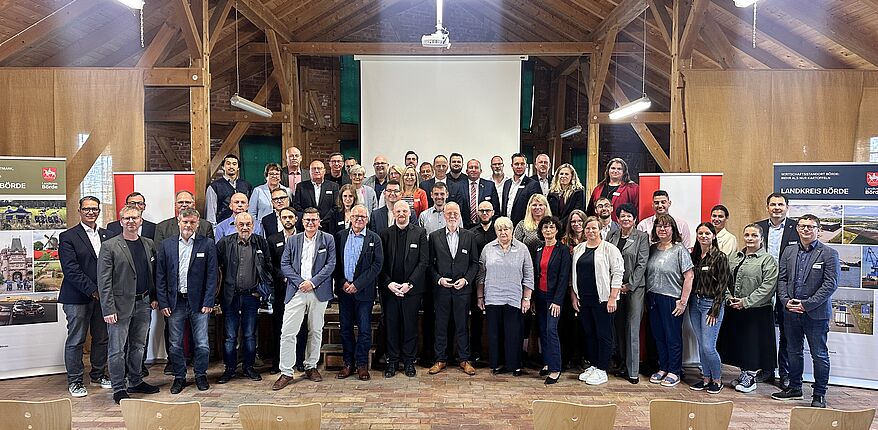
Under the title “The Börde District: A Region of the Future – An Interconnected Area of Mining and High-Tech”, the district brought together representatives from federal and state politics, local authorities, business, academia and the professional sector. The focus was on the RegioStrat pilot project, through which the district is realigning its strategic regional development for the coming years.
In his opening address, District Administrator Martin Stichnoth made it clear that the district’s future is not determined solely by decisions taken at higher political levels: “The future of the Börde District does not just happen by itself. It is not decided in Berlin or Brussels. It is decided and shaped here and now by all of us together.”
In her welcoming address, Dr Lydia Hüskens, Minister for Infrastructure and Digitalisation for the State of Saxony-Anhalt, also focused on the question of how infrastructure and regional development at local authority level can support change in rural areas.
The Börde district as one of twelve model regions nationwide
The District Administrator spoke with particular pride of the success achieved in the nationwide competition organised by the Federal Institute for Research on Building, Urban Affairs and Spatial Development (BBSR). The Börde district is one of just twelve selected regions to take part in the RegioStrat pilot project between 2026 and 2028. This comes with federal funding of 450,000 euros.
“It is no coincidence that the Börde was chosen,” emphasised Stichnoth. The guiding principle “The Börde District: a region of the future – an interlinked area of mining and high-tech” describes the region’s unique starting point. RegioStrat offers the opportunity to set the strategic course for the next 15 years, whilst deliberately thinking beyond traditional administrative and municipal boundaries.
Project manager Danny Schonscheck presented the current status of the Strategic Regional Development Concept (SREK). The aim is to integrate the various areas of regional development – including public services, housing, infrastructure and mobility – more closely with one another.
Vision 2040: Combining innovation and quality of life
Affordable housing, a sustainable quality of life and modern working environments are to be considered as an integrated whole. Families should be able to make the district their home, whilst digitalisation and new ways of working enable a close link between home and work.
Public services, too, are set to operate comprehensively, with digital support and reliably by 2040. Telemedicine, mobile practice models and innovative care concepts could help ensure that medical services remain easily accessible even in rural areas.
With regard to mobility, RegioStrat envisages a demand-driven, digitally organised and largely emission-free public transport system.
Strong partners as the key to transformation
The Summer Meeting also demonstrated that this vision can only be realised within a strong regional network. Alongside the district administration, local authorities, the Regional Planning Association, state authorities, businesses, academic institutions and other partners from the field were involved.
The expert presentations throughout the day highlighted the range of challenges and potential solutions. Alongside strategic regional development, the agenda included local public transport, medical care in rural areas, mobile doctors’ surgeries, autonomous mobility and logistics, drones and physical artificial intelligence, as well as digital applications and the Galileo test bed in Saxony-Anhalt.
The current stage of development of Lake Lappwald was also presented. This highlighted the connection between the various facets of regional transformation: from managing structural change and safeguarding essential public services to harnessing new technological opportunities.
RegioStrat as a collaborative process
The Summer Meeting was explicitly not intended merely as a review of the current situation. Rather, the exchange was intended to prepare the ground for the next step in the RegioStrat process.
“We have the vision, we have the bright minds, and thanks to RegioStrat and our strong partners, we have the right tools,” said District Administrator Stichnoth.
This collaboration is set to be further intensified in the coming years. The Börde district intends, together with its partners, to develop concrete projects and lay the strategic foundations to ensure that the region remains a liveable, productive and future-proof place, even in the face of demographic, economic and technological change.
The Alte Ziegelei Hundisburg provided a fitting setting for the Summer Meeting: a historic site of industrial production became the venue for exploring what the next generation of regional development might look like.