Landkreis Börde - Amt für Natur- und Umweltschutz - Sachgebiet Immissionsschutz

.

Unsere Leistungen

zurück zur Übersicht

What "immission" means.

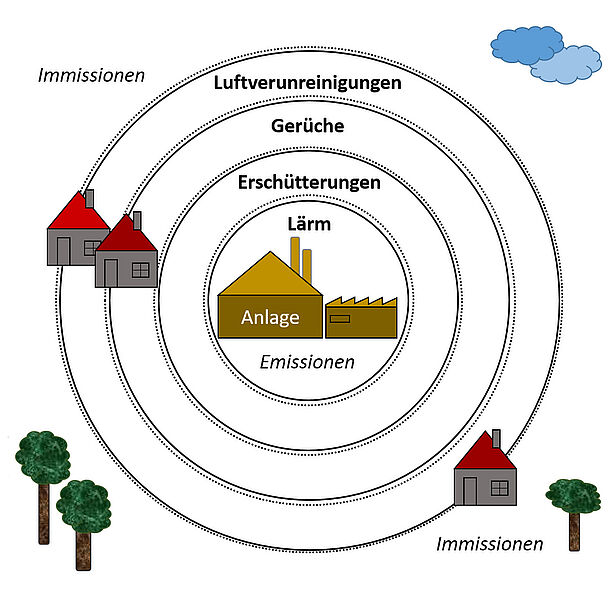
Air pollution (e.g. gases, dust), noise, vibrations, odours, light, heat, radiation and similar environmental impacts

Immission control objectives.

To protect humans, animals, plants, soil, water, atmosphere, cultural and other material assets from harmful environmental impacts caused by immissions and to prevent the occurrence of harmful environmental impacts (precaution)

The Federal Immission Control Act summarises all of this.

The Federal Immission Control Act (BImSchG) forms the basis for our work and encompasses all of the above-mentioned objectives. It is therefore one of the most important laws in the field of environmental protection. Further regulations for the concretisation of environmental law are the Federal Immission Control Ordinances and the Technical Instructions for Noise and Air TA Lärm / TA Luft.

Landkreis Börde - Office for Planning and Environment - Immission Control Division

Tasks of the Immission Control Department

  • Small combustion plants
  • Chemical safety
  • Plants requiring a permit
  • Air pollution, odor nuisance, neighborhood complaints
  • Noise, vibrations
  • Immission control requirements in the building permit procedure

Useful information

Installations requiring a permit (under the Federal Immission Control Act)

Installations requiring authorisation under the Federal Immission Control Act (installations subject to authorisation – Section 4 of the Federal Immission Control Act)

Numerous technical installations within the meaning of the Federal Immission Control Act require a permit, for example: large paint shops, scrap yards, livestock facilities above a certain stocking density, open-air motor sport facilities, open-air shooting ranges and shooting grounds, wind turbines with a total height of more than 50 metres, biogas plants and much more. The authorisation threshold is set out in the 4th Federal Immission Control Ordinance. The building permit is included in the BImSchG authorisation. Substantial changes are subject to authorisation. A wide range of changes affecting the installation must be notified in accordance with Section 15 of the Federal Immission Control Act (BImSchG). Notifications under Section 15 BImSchG are made informally to the immission control authority, accompanied by the documents required for assessment.

Before submitting an application, it is advisable to have a consultation with the relevant case officer regarding the nature and scope of the application documents.

For some installations, in accordance with Annex 1 of the Environmental Impact Assessment Act (list of ‘projects subject to an EIA’), a preliminary environmental impact assessment (general or site-specific) or an environmental impact assessment (EIA) must be carried out.
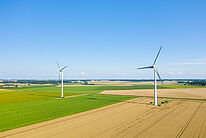
Wind turbines
AdobeStock

Wind turbines/wind power plants (WKA/WEA)


Installations under building regulations
AdobeStock

Installations requiring planning permission under building regulations (installations not requiring planning permission – Section 22 of the Federal Immission Control Act (BImSchG))

For all other projects which do not require authorisation under the Federal Immission Control Act, but for which the granting of planning permission is essential, the assessment under immission control law is carried out as part of the planning permission procedure.


We require detailed documentation as the basis for an assessment under immission control law. You may use the following checklist as a guide:

Combustion, gas turbine or internal combustion engine installations (44th BImSchV)
AdobeStock

Registration of combustion plants under the 44th BImSchV

With the entry into force of the 44th BImSchV on 13 June 2019, a registration requirement was introduced for combustion plants falling within the scope of the 44th BImSchV. Under Section 6, operators of such combustion plants must notify the competent authority before commissioning them. Existing combustion plants as defined in Section 2(4) of the 44th BImSchV must be notified by 1 December 2023. Individual combustion plants with a thermal input (FWL) of less than 1 MW are exempt from the notification requirement.

For the notification to the plant register for medium-sized combustion, gas turbine or internal combustion engine plants – 44th BImSchV – you will find below a form in accordance with Annex 1 of the Regulation.

All notifications submitted in accordance with Section 6 of the 44th BImSchV are recorded in a plant register within one month of receipt and verification of the notification’s completeness; this register is updated monthly and then published. The current plant register can be found here.

Light pollution

Light emissions from light-emitting installations

The guidelines issued by the Federal/State Working Group on Pollution Control (LAI) apply to the assessment of the effects of light emissions on people caused by light-emitting installations of all kinds, provided that these are installations or components of installations within the meaning of Section 3(5) of the Federal Immission Control Act (BImSchG). Light-emitting installations include artificial light sources of all kinds, such as floodlights for illuminating sports facilities, illuminated advertising, all possible types of fixed lighting, etc. Adverse environmental effects are deemed to exist where the neighbourhood or the general public is significantly inconvenienced.

Guidance on the measurement, assessment and mitigation of light emissions from the Federal/State Working Group on Immission Control (LAI)

Small and medium-sized combustion plants (1st BImSchV)

This Regulation applies to the construction, the design and operation of combustion plants which do not require authorisation under Section 4 of the Federal Immission Control Act, with the exception of combustion plants designed to burn gaseous or liquid fuels with a thermal input of 1 megawatt or more.


This regulation does not apply, amongst other things, to:

  • combustion plants which, in accordance with the state of the art, can be operated without a flue gas discharge system, in particular infrared heaters,
  • combustion plants intended to
  1. dry goods by direct contact with hot flue gases,
  2. baking food or preparing it in a similar manner through direct contact with hot flue gases,
  3. the production of alcohol in small distilleries with an annual output of no more than 10 hectolitres of alcohol and an annual operating period of no more than 20 days, or
  4. to produce hot water in bath stoves (except for wood-fired hot tubs).

In the case of a solid fuel combustion plant erected after 31 December 2021, if the distance between the new chimney system to be erected and the nearest residential development is less than 15 metres, compliance with Section 19 (1) 2. of the 1st BImSchV is essential.

1st BImSchV

Chemicals legislation

Chemicals legislation covers, amongst other things, the following points:

  • Chemicals Act
  • Hazardous Substances Ordinance
  • Regulation on the Prohibition of Certain Chemicals
  • Enforcement of the 2nd, 28th and 31st BImSchV
  • Monitoring of asbestos disposal
  • Monitoring of petrol stations in accordance with the 10th, 20th and 21st BImSchV
  • Recording and monitoring in the retail sector with regard to hazardous substances, as well as sampling
Heat pumps (Guidance on clearances)

You may find the following guide useful:

The Guide to Improving Noise Protection for Stationary Equipment, published by the Federal/State Working Group on Emission Control (LAI) in August 2013 (updated March 2020) provides a technically sound basis for the planning and installation of air-source heat pumps.

Guideline

Recommended distances depending on the sound power level of the heat pump:


Sound power level Operating hours Purely residential area (WR) General residential area (WA) Village/mixed-use area (MD/MI)
50 dB(A) at night 12.40 m 06.70 m 03.40 m
50 dB(A) at night 22.20 m 12.40 m 06.70 m
60 dB(A) at night 31.80 m 22.20 m 12.40 m


The Bavarian State Office for the Environment considers a sound power level of 50 dB(A) to represent the state of the art in noise abatement for air-source heat pumps. According to the LAI guidelines of August 2013, units are already available that produce a sound power level of less than 50 dB(A). The distances given do not take into account noise barriers or multiple reflections, which may result in the distances being doubled.